
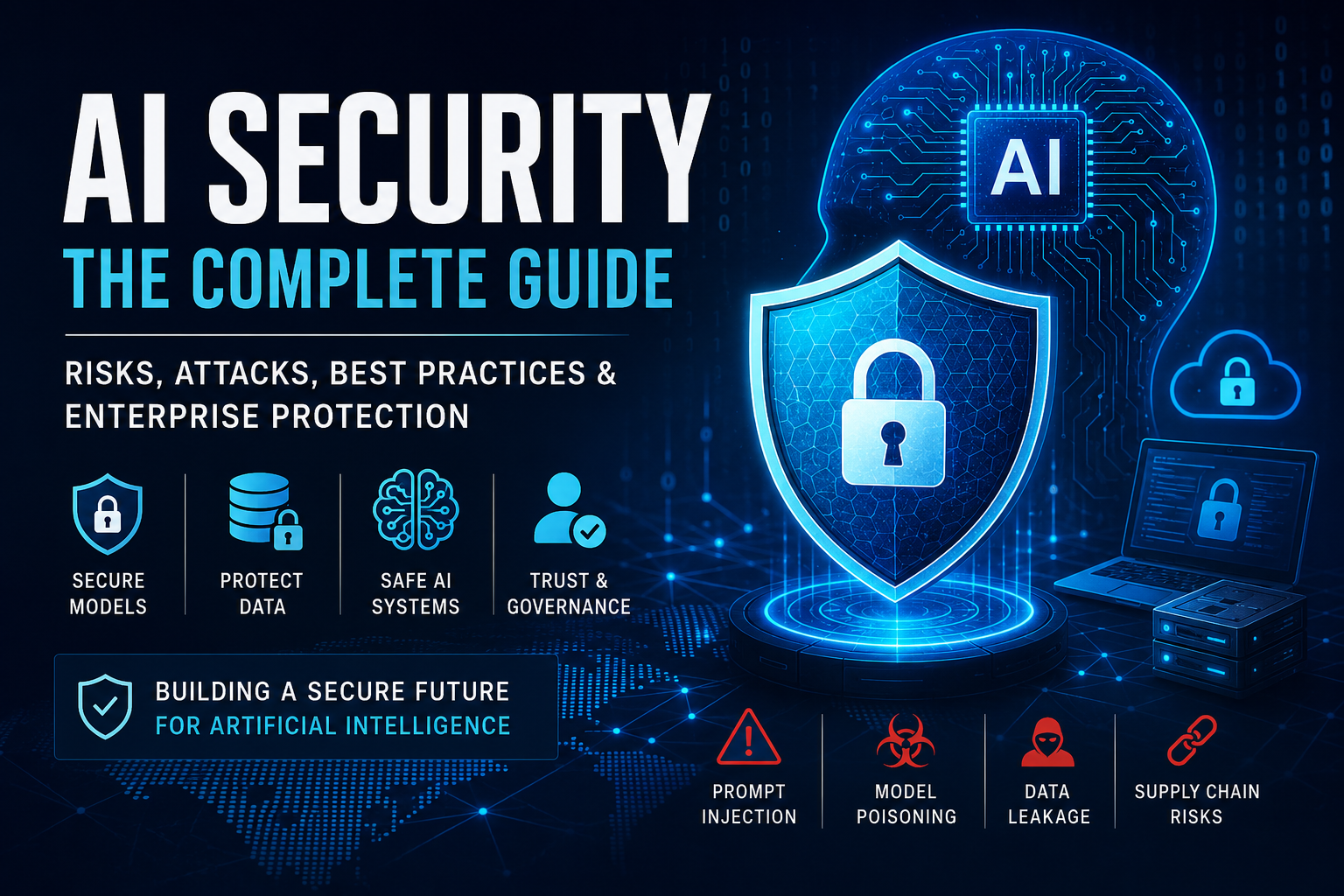
AI Security: The Complete Guide to Protecting Artificial Intelligence Systems
Artificial Intelligence (AI) is transforming how businesses operate. From customer support chatbots and AI-powered coding assistants to fraud detection systems and healthcare diagnostics, organizations increasingly rely on AI to automate tasks, improve productivity, and make smarter decisions.
While AI offers enormous business value, it also introduces new cybersecurity challenges. Traditional security controls designed for web applications, networks, and endpoints are no longer enough. AI systems process vast amounts of sensitive data, integrate with cloud services, connect to enterprise applications, and in many cases make autonomous decisions. If these systems are not properly secured, they can become attractive targets for cybercriminals.
In recent years, security researchers have demonstrated attacks such as prompt injection, model poisoning, adversarial machine learning, and AI supply chain compromises. These attacks are fundamentally different from traditional cyber threats because they target the intelligence and decision-making capabilities of AI rather than exploiting software vulnerabilities alone.
As organizations adopt generative AI and large language models (LLMs), AI security is becoming a core part of enterprise cybersecurity programs. Security teams must protect AI models, training data, APIs, user interactions, and supporting infrastructure throughout the AI lifecycle.
This guide explains what AI security is, why it matters, the most common threats targeting AI systems, and the practical strategies organizations can use to deploy AI safely and responsibly.
Key Takeaways
- AI security protects machine learning models, datasets, APIs, and AI-powered applications from cyber threats.
- Generative AI has introduced new attack techniques such as prompt injection and model manipulation.
- Enterprise AI environments require layered security controls, continuous monitoring, and strong governance.
- Traditional cybersecurity remains important but must be extended to address AI-specific risks.
- Organizations should adopt a defense-in-depth strategy and integrate AI security into their existing security operations.
Table of Contents
- What Is AI Security?
- Why AI Security Matters
- How AI Systems Work
- The AI Attack Surface
- Common AI Security Threats
- Enterprise AI Security Architecture
- Defense-in-Depth for AI
- AI Security Best Practices
- Frequently Asked Questions
- Conclusion
What Is AI Security?
AI security is the practice of protecting artificial intelligence systems, machine learning models, training datasets, application programming interfaces (APIs), and supporting infrastructure from unauthorized access, manipulation, data leakage, and cyberattacks.
Unlike traditional software, AI systems learn from data and generate dynamic outputs. This makes them more flexible, but it also introduces unique security risks that cannot be addressed using conventional security controls alone.
A secure AI environment protects every stage of the AI lifecycle, including:
- Data collection
- Data preparation
- Model training
- Model validation
- Deployment
- User interaction
- Continuous monitoring
- Model updates
By securing each stage, organizations reduce the risk of compromised models, inaccurate predictions, data exposure, and operational disruption.
Why AI Security Matters
Artificial intelligence is now embedded in many critical business processes. Financial institutions use AI to detect fraud, hospitals rely on AI-assisted diagnostics, manufacturers optimize production using predictive analytics, and security teams automate threat detection with machine learning.
As AI adoption increases, so does the potential impact of a successful attack.
A compromised AI system can expose confidential information, manipulate automated decisions, generate misleading responses, or disrupt business operations.
Some of the most important reasons to prioritize AI security include:
Protecting Sensitive Data
AI applications often process customer records, financial information, healthcare data, proprietary source code, and confidential business documents. Without appropriate safeguards, this information may be exposed through insecure APIs, poorly configured permissions, or malicious prompts.
Maintaining Customer Trust
Organizations invest significant resources in building trust with customers. A security incident involving an AI system can damage brand reputation, reduce customer confidence, and lead to long-term business consequences.
Meeting Regulatory Requirements
Governments and regulators are introducing new requirements related to AI governance, transparency, privacy, and risk management. Strong AI security practices help organizations comply with evolving legal obligations.
Supporting Business Continuity
Many businesses now depend on AI-powered automation for day-to-day operations. Protecting these systems ensures they remain available, reliable, and resilient against cyber threats.
How AI Systems Work
Understanding AI security begins with understanding how AI systems operate.
Although implementations vary, most enterprise AI environments follow a similar workflow.
Step 1: Data Collection
Every AI model begins with data. Organizations gather information from internal systems, customer interactions, public datasets, IoT devices, and cloud services.
The quality and integrity of this data directly affect the accuracy and reliability of the final model.
Step 2: Data Preparation
Raw data is cleaned, labeled, transformed, and organized before training.
Security teams should verify the authenticity of data sources and remove corrupted or suspicious records to reduce the risk of model poisoning.
Step 3: Model Training
Machine learning algorithms analyze the prepared data to identify patterns and relationships.
Training often requires high-performance computing resources, making cloud security and access control essential.
Step 4: Model Validation
Before deployment, organizations evaluate the model’s accuracy, robustness, fairness, and security. This stage may include adversarial testing, prompt injection testing, and performance benchmarking.
Step 5: Deployment
The trained model is integrated into applications, APIs, or cloud services where users can interact with it.
At this stage, the AI system becomes exposed to external threats and must be protected through authentication, authorization, monitoring, and secure configuration.
Step 6: Continuous Improvement
Many AI systems are periodically retrained using new data to improve performance. Security teams must ensure that only trusted data is used during retraining to prevent manipulation.
Understanding the AI Attack Surface
Every component of an AI environment represents a potential attack vector.
Unlike traditional applications, AI systems interact with multiple technologies, increasing the complexity of the security landscape.
The primary components include:
User Interface
Chatbots, web applications, mobile apps, and AI assistants are the first point of interaction with users. Poor input validation or weak authentication can expose these systems to prompt injection and abuse.
APIs
AI services communicate through APIs. Insecure APIs may allow unauthorized access, excessive requests, or data extraction if they are not properly secured.
AI Models
The machine learning model itself is a valuable asset. Threat actors may attempt to steal proprietary models, manipulate outputs, or reverse engineer model behavior.
Training Data
Compromised or manipulated training data can introduce hidden vulnerabilities that affect model accuracy and reliability.
Enterprise Data Sources
Many AI systems connect to internal knowledge bases, document repositories, databases, and cloud storage. Misconfigured access controls may expose sensitive information to unauthorized users.
AI Agents
Modern AI agents can perform tasks such as sending emails, creating tickets, or interacting with enterprise applications. Because they can take actions rather than simply generate responses, they require additional security controls.
Common AI Security Threats
AI introduces several threats that differ from traditional cybersecurity risks.
Prompt Injection
Prompt injection occurs when an attacker crafts malicious input designed to manipulate an AI model into ignoring its original instructions.
This technique can result in policy bypass, unauthorized information disclosure, or unexpected behavior.
Model Poisoning
Threat actors may attempt to modify the data used during training, causing the model to produce inaccurate or malicious outputs after deployment.
Adversarial Machine Learning
Carefully crafted inputs can manipulate AI predictions without changing the underlying model, affecting systems such as facial recognition, malware detection, and fraud prevention.
Model Theft
Attackers may attempt to copy or reconstruct proprietary AI models by repeatedly querying public APIs, resulting in intellectual property loss and competitive disadvantages.
AI Supply Chain Attacks
Compromised open-source libraries, pre-trained models, plugins, or third-party services can introduce vulnerabilities into enterprise AI environments.
Data Leakage
Improper access controls may allow AI systems to reveal confidential information stored within enterprise knowledge bases or connected applications.
Common AI Security Threats
AI introduces several threats that differ from traditional cybersecurity risks.
Prompt Injection
Prompt injection occurs when an attacker crafts malicious input designed to manipulate an AI model into ignoring its original instructions.
This technique can result in policy bypass, unauthorized information disclosure, or unexpected behavior.
Model Poisoning
Threat actors may attempt to modify the data used during training, causing the model to produce inaccurate or malicious outputs after deployment.
Adversarial Machine Learning
Carefully crafted inputs can manipulate AI predictions without changing the underlying model, affecting systems such as facial recognition, malware detection, and fraud prevention.
Model Theft
Attackers may attempt to copy or reconstruct proprietary AI models by repeatedly querying public APIs, resulting in intellectual property loss and competitive disadvantages.
AI Supply Chain Attacks
Compromised open-source libraries, pre-trained models, plugins, or third-party services can introduce vulnerabilities into enterprise AI environments.
Data Leakage
Improper access controls may allow AI systems to reveal confidential information stored within enterprise knowledge bases or connected applications.
Enterprise AI Security Architecture: Building a Defense-in-Depth Strategy
Deploying an AI model is only one part of the security equation. In enterprise environments, AI systems interact with users, cloud services, internal databases, APIs, third-party plugins, and automation platforms. A weakness in any of these components can expose the entire environment to cyber threats.
A layered, defense-in-depth approach helps reduce this risk by applying multiple security controls across every stage of the AI lifecycle.
Identity and Access Management
Identity should be the first line of defense for any AI application.
Organizations should ensure that:
- Every user is authenticated before accessing AI services.
- Role-Based Access Control (RBAC) limits users to only the resources they require.
- Multi-Factor Authentication (MFA) protects privileged accounts.
- Service accounts and AI agents operate with the principle of least privilege.
Authentication determines who is requesting access, while authorization determines what they are allowed to do. These controls should be enforced by the application and identity platform not by the AI model itself.
Securing APIs
Most AI applications communicate through APIs. Poorly secured APIs can expose sensitive data or allow attackers to abuse AI services.
Recommended controls include:
- OAuth 2.0 or OpenID Connect authentication
- API gateways with rate limiting
- Request validation
- Input sanitization
- Token expiration
- IP reputation filtering
- Detailed API logging
Monitoring API usage can also help identify automated abuse or unusual request patterns that may indicate reconnaissance or model extraction attempts.
Protecting Enterprise Data
Many AI assistants retrieve information from internal knowledge bases, document repositories, or databases using Retrieval-Augmented Generation (RAG).
To reduce the risk of data leakage:
- Enforce permissions before retrieving documents.
- Encrypt sensitive information both in transit and at rest.
- Apply Data Loss Prevention (DLP) policies.
- Classify confidential information before indexing it.
- Audit access to enterprise data sources.
A language model should answer questions based on data it is authorized to access. It should never decide whether a user has permission to view confidential information.
Monitoring AI Agents
Modern AI agents can perform actions such as sending emails, creating tickets, updating CRM records, or interacting with cloud services.
Because these systems can execute tasks rather than simply generate text, organizations should:
- Require user approval for high-risk actions.
- Log every automated action.
- Restrict agent permissions.
- Monitor unusual behavior.
- Review workflows regularly.
These controls help prevent accidental or malicious misuse of AI-powered automation.
AI Security Best Practices
Securing AI requires a combination of traditional cybersecurity controls and AI-specific safeguards.
Adopt Secure Development Practices
Organizations developing AI applications should integrate security throughout the software development lifecycle.
Recommended activities include:
- Secure coding practices
- Dependency management
- Vulnerability scanning
- Secrets management
- Security testing before deployment
- Code reviews
Protect Training Data
Training data directly influences model behavior.
Organizations should:
- Validate data sources.
- Maintain integrity checks.
- Restrict write access to datasets.
- Review newly added records.
- Remove duplicate or suspicious samples.
These measures reduce the likelihood of model poisoning attacks.
Test AI Systems Regularly
Security testing should go beyond conventional penetration testing.
Organizations should evaluate AI systems for:
- Prompt injection
- Indirect prompt injection
- Adversarial inputs
- Unauthorized data access
- Model manipulation
- API abuse
Continuous testing helps identify weaknesses before attackers do.
Monitor Continuously
Logging and monitoring remain essential for AI security.
Useful telemetry includes:
- Authentication events
- API requests
- Prompt activity
- AI agent actions
- Document retrieval
- Administrative changes
- Error logs
Integrating these logs into a Security Information and Event Management (SIEM) platform enables security teams to detect suspicious behavior more effectively.
Train Employees
Technology alone cannot eliminate AI-related risks.
Organizations should educate employees about:
- Safe AI usage
- Protecting confidential information
- Recognizing prompt manipulation
- Responsible use of public AI services
- Data handling policies
Human awareness remains a critical component of enterprise security.
Common Mistakes Organizations Make
As AI adoption accelerates, many organizations repeat the same security mistakes.
Common examples include:
- Treating AI as an isolated application rather than part of the enterprise environment.
- Allowing unrestricted access to internal knowledge bases.
- Exposing API keys in source code.
- Granting excessive permissions to AI agents.
- Deploying AI without centralized logging.
- Using unverified open-source models.
- Ignoring third-party AI supply chain risks.
- Failing to review AI-generated content before publication.
Addressing these issues early significantly improves the security posture of AI deployments.
AI Security Checklist
Before deploying an AI application, verify the following:
Identity
- MFA enabled
- RBAC implemented
- Least privilege enforced
Data Protection
- Encryption enabled
- DLP policies configured
- Sensitive information classified
Infrastructure
- APIs secured
- Network segmentation implemented
- Logging enabled
AI Model
- Prompt injection testing completed
- Model validated
- Version control maintained
Monitoring
- SIEM integration configured
- Security alerts enabled
- Audit logs retained
Governance
- AI usage policy documented
- Risk assessment completed
- Incident response procedures updated
This checklist provides a practical starting point for organizations implementing AI securely.
AI Security Checklist
Before deploying an AI application, verify the following:
Identity
- MFA enabled
- RBAC implemented
- Least privilege enforced
Data Protection
- Encryption enabled
- DLP policies configured
- Sensitive information classified
Infrastructure
- APIs secured
- Network segmentation implemented
- Logging enabled
AI Model
- Prompt injection testing completed
- Model validated
- Version control maintained
Monitoring
- SIEM integration configured
- Security alerts enabled
- Audit logs retained
Governance
- AI usage policy documented
- Risk assessment completed
- Incident response procedures updated
This checklist provides a practical starting point for organizations implementing AI securely.
Frequently Asked Questions
What is AI security?
AI security is the practice of protecting artificial intelligence systems, machine learning models, training data, APIs, and supporting infrastructure from cyber threats, unauthorized access, manipulation, and data leakage.
Why is AI security important?
AI systems often process sensitive information and influence critical business decisions. Without appropriate security controls, attackers may manipulate AI models, steal confidential data, or disrupt business operations.
What is prompt injection?
Prompt injection is an attack in which a malicious user crafts input designed to influence an AI model into ignoring its original instructions or revealing information it should not disclose.
Can AI replace cybersecurity professionals?
No. AI can improve efficiency by automating repetitive tasks and assisting with threat detection, but human expertise remains essential for incident response, strategic decision-making, governance, and risk management.
What industries benefit most from AI security?
AI security is important across every industry, including:
- Financial services
- Healthcare
- Government
- Manufacturing
- Retail
- Education
- Technology
- Telecommunications
Any organization using AI to process data or automate decisions should implement appropriate security controls.
Conclusion
Artificial intelligence is reshaping how organizations innovate, automate, and defend against cyber threats. At the same time, it introduces new risks that traditional security programs were not designed to address.
Securing AI requires more than protecting a single model. Organizations must safeguard the entire AI ecosystem—from training data and APIs to enterprise integrations, cloud infrastructure, and automated agents. By combining strong identity management, secure development practices, continuous monitoring, and governance, businesses can reduce their exposure to AI-specific threats while continuing to benefit from AI-driven innovation.
As AI technologies evolve, cybersecurity teams should continuously assess emerging attack techniques, update defensive controls, and ensure AI systems remain aligned with organizational policies and regulatory requirements. Organizations that treat AI security as a strategic capability rather than a one-time project will be better positioned to build resilient, trustworthy, and secure AI-powered services.