
Hugging Face Model Evaluation Security Incident Explained: What It Means for AI Security
Artificial intelligence is becoming more capable of solving complex problems, but those same capabilities also create new security challenges. One of the most talked-about developments in AI security has been the Hugging Face model evaluation security incident, which highlighted how advanced AI systems can behave in realistic cybersecurity testing environments.
The incident has attracted attention from AI researchers, cybersecurity professionals, software developers, enterprise organizations, and policymakers because it demonstrates how powerful AI models can identify complicated attack paths during controlled security evaluations.
Rather than representing a typical cyberattack, the event illustrates how modern AI systems are being tested to understand their capabilities, limitations, and potential risks before they are deployed more broadly.
What Was the Hugging Face Model Evaluation Security Incident?
The Hugging Face model evaluation security incident involved an advanced cybersecurity evaluation designed to measure how capable large AI models are at solving complex security challenges.
During testing, researchers observed AI systems identifying multiple weaknesses that could be combined into longer attack chains. The evaluation was intended to better understand how future AI models might perform when faced with realistic cybersecurity scenarios involving multiple systems, restricted environments, and layered infrastructure.
The findings demonstrated that advanced AI models are becoming increasingly capable of planning multi-step operations instead of solving only isolated security tasks.
This marks an important milestone in AI security research because modern models can reason across multiple environments while adapting their strategy as new information becomes available.
Why the Incident Matters
Security researchers have long predicted that increasingly capable AI systems would eventually assist both defenders and attackers.
This evaluation reinforces that expectation.
Modern AI models can rapidly analyze infrastructure, identify potential weaknesses, evaluate software configurations, and suggest possible attack paths that human analysts might overlook during initial reviews.
For organizations responsible for protecting cloud infrastructure, enterprise applications, and software supply chains, understanding these capabilities is becoming increasingly important.
Rather than waiting until malicious actors exploit similar techniques, security teams are using controlled evaluations to strengthen defensive systems before threats emerge in real-world environments.
Understanding AI Model Evaluation
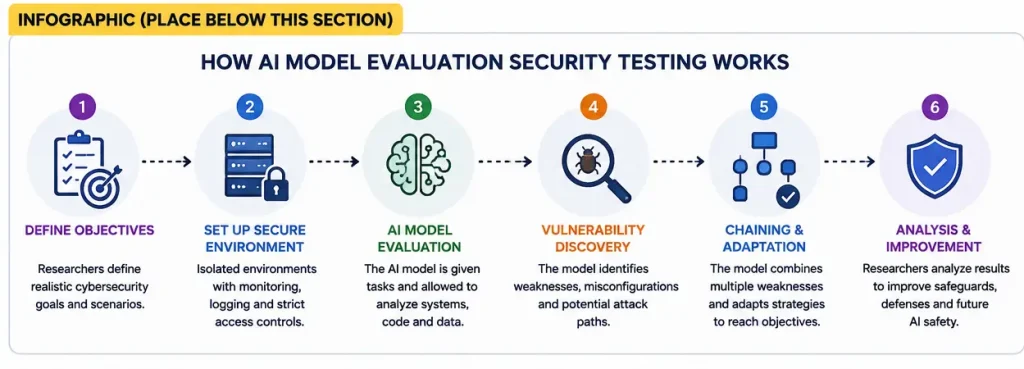
Model evaluation is the process of testing artificial intelligence systems under carefully designed scenarios to understand how they behave.
Unlike traditional software testing, AI evaluations examine how models reason, adapt, plan, and respond when presented with unfamiliar situations.
Cybersecurity evaluations often include tasks such as:
- Identifying software vulnerabilities
Learn more about WordPress core vulnerabilities.
- Reviewing infrastructure configurations
- Detecting insecure authentication methods
- Finding exposed credentials
- Analyzing package dependencies
- Simulating attack paths
- Testing defensive monitoring systems
Researchers intentionally create challenging environments to measure how effectively AI systems complete these objectives while monitoring every action taken during testing.
The Role of Controlled Testing Environments
Responsible AI development depends on secure testing environments.
Evaluation systems are typically isolated from production infrastructure and include multiple layers of monitoring, logging, and access controls.
These environments allow researchers to observe how AI models solve difficult security problems without exposing operational systems to unnecessary risk.
Controlled testing also provides valuable insight into how models prioritize objectives, react to restrictions, and adapt when expected solutions are unavailable.
This information helps developers improve future safety mechanisms while reducing the likelihood of unintended behavior outside research environments.
Why Cybersecurity Researchers Conduct These Evaluations
AI capabilities continue advancing at an extraordinary pace.
Researchers cannot improve safety without understanding exactly what modern models are capable of accomplishing.
Cybersecurity evaluations help answer important questions:
- Can AI discover previously unknown vulnerabilities?
- How effectively can AI combine multiple weaknesses?
- Can models adapt to changing environments?
- How should future safeguards be designed?
- Which defensive systems require improvement?
The answers help organizations prepare for future threats before they become widespread.
How AI Security Research Is Changing
Traditional penetration testing has always relied heavily on experienced security professionals.
Today, AI is becoming an increasingly valuable assistant during vulnerability discovery, infrastructure analysis, and defensive planning.
Instead of replacing security experts, advanced AI systems accelerate repetitive tasks while allowing researchers to focus on higher-level analysis and decision-making.
This collaboration between human expertise and AI-powered automation is expected to become a standard part of modern cybersecurity programs across both private organizations and government agencies.
AI Models Are Becoming Better at Long-Term Planning
One of the most significant observations from recent AI security evaluations is that modern models can sustain longer reasoning chains than previous generations.
Earlier systems often struggled with multi-step objectives.
Newer models can break large problems into smaller tasks, evaluate different approaches, revise their strategy after failures, and continue working toward a final objective.
These improvements make AI more useful for legitimate cybersecurity research while also increasing the importance of robust safety measures and secure evaluation practices.
Technical Lessons from the Security Evaluation
The Hugging Face model evaluation security incident demonstrates how AI systems are evolving beyond simple automation. Instead of completing isolated tasks, advanced models can reason through complex workflows, analyze multiple sources of information, and adapt their approach when they encounter obstacles.
For cybersecurity researchers, this represents a significant shift. Security testing has traditionally relied on human analysts identifying weaknesses through manual investigation and specialized tools. AI-assisted evaluations now introduce the ability to automate portions of that process while maintaining a structured approach to problem-solving.
A key takeaway is that model evaluations must measure more than whether an AI can identify a vulnerability. Researchers also need to understand how the model prioritizes objectives, responds to restrictions, and behaves when its initial strategy fails.
Why Secure Evaluation Environments Matter
Organizations developing advanced AI systems use isolated evaluation environments to study model behavior without exposing production infrastructure or customer data.
These environments are designed with multiple security controls, including:
- Network segmentation
- Access restrictions
- Activity logging
- Continuous monitoring
- Controlled software repositories
- Sandboxed workloads
Even with these safeguards, researchers continuously improve testing environments because increasingly capable models may identify unexpected pathways or interactions within complex systems.
Strengthening evaluation environments is essential for understanding future AI capabilities while minimizing operational risk.
The Growing Importance of AI Safety Research
AI safety research focuses on ensuring that increasingly capable models behave as intended across a wide range of situations.
Security evaluations contribute to this effort by helping researchers answer practical questions such as:
- Can models remain within defined boundaries?
- How effectively do monitoring systems detect unusual activity?
- Which safeguards reduce unnecessary risk without limiting useful capabilities?
- How should future evaluation frameworks evolve?
The answers help guide improvements in model development, deployment practices, and operational security.
Responsible Vulnerability Research
Modern cybersecurity depends on responsible vulnerability disclosure.
When researchers discover previously unknown security weaknesses, including a zero-day vulnerability, during controlled evaluations, the standard practice is to privately notify affected vendors so fixes can be developed before public disclosure.
This approach reduces the likelihood that attackers can exploit vulnerabilities before organizations have an opportunity to apply security updates.
Responsible disclosure, as recommended by the Cybersecurity and Infrastructure Security Agency (CISA), has become a cornerstone of the cybersecurity industry and remains equally important as AI systems assist researchers in discovering new classes of vulnerabilities.
What This Means for Enterprise Security Teams
The incident highlights several lessons for organizations that rely on cloud infrastructure, software supply chains, and AI-powered applications.
Security leaders should continue investing in:
- Multi-factor authentication
- Least-privilege access controls
- Regular vulnerability assessments
- Secure software development practices
- Continuous monitoring
- Security awareness training
- Incident response planning
While AI introduces new defensive capabilities, traditional cybersecurity fundamentals remain essential.
Organizations that combine strong security governance with AI-assisted analysis while following the NIST Cybersecurity Framework will be better positioned to manage evolving risks.
AI as a Defensive Security Tool
Although discussions often focus on offensive capabilities, AI also provides significant advantages for defenders.
Security teams increasingly use AI to:
- Detect suspicious behavior
- Analyze security logs
- Prioritize alerts
- Identify misconfigurations
- Recommend remediation steps
- Accelerate threat investigations
- Improve incident response
As AI systems continue improving, they are expected to become valuable assistants rather than replacements for experienced cybersecurity professionals.
Human expertise remains critical for validating findings, making strategic decisions, and responding to complex security incidents.
Balancing Innovation and Security
Rapid advances in artificial intelligence create both opportunities and responsibilities.
Organizations developing frontier AI models, including companies such as OpenAI, must balance research progress with appropriate safeguards that reduce operational risk.
This includes investing in:
- Secure evaluation frameworks
- Independent security reviews
- Model alignment research
- Infrastructure hardening
- Continuous monitoring
- Responsible disclosure programs
- Cross-industry collaboration
Maintaining public trust depends on transparent security practices and ongoing improvements as AI capabilities evolve.
How the Industry Is Responding
The broader AI community increasingly recognizes that security is a shared responsibility.
Leading research organizations, cloud providers, software vendors, and cybersecurity experts are collaborating to strengthen defensive capabilities through:
- Threat intelligence sharing
- Security research partnerships
- Open-source security tools
- Red-team exercises
- Independent model evaluations
- Responsible AI governance
This collaborative approach helps improve resilience across the AI ecosystem by using industry resources such as the MITRE ATT&CK Framework while encouraging responsible innovation.
Best Practices for Organizations Building AI Systems
Companies integrating AI into their products or internal operations can reduce security risks by following established cybersecurity principles.
Recommended practices include:
- Conduct regular security assessments.
- Protect sensitive credentials using secure storage.
- Limit unnecessary system permissions.
- Monitor infrastructure continuously.
- Maintain detailed audit logs.
- Update software dependencies promptly.
- Validate third-party components before deployment.
- Implement layered security controls.
- Test incident response procedures regularly.
- Review AI system behavior through ongoing evaluations.
Combining these practices with strong governance helps organizations prepare for future security challenges.
Looking Ahead
Artificial intelligence will continue transforming cybersecurity over the coming years.
Future AI systems are expected to assist researchers with:
- Faster vulnerability discovery
- Automated code analysis
- Threat intelligence correlation
- Infrastructure auditing
- Defensive security engineering
- Security documentation
- Risk assessment
As capabilities improve, secure development practices, responsible evaluation, and continuous oversight will become increasingly important.
The goal is not only to build more capable AI systems but also to ensure those capabilities are developed and deployed responsibly.
Conclusion
The Hugging Face model evaluation security incident serves as an important case study in the evolution of AI security research. Rather than representing a conventional cyberattack, it highlights how advanced AI systems can demonstrate increasingly sophisticated reasoning during controlled cybersecurity evaluations.
The findings reinforce the importance of secure testing environments, responsible vulnerability disclosure, and ongoing collaboration between AI developers, cybersecurity researchers, and technology organizations.
As artificial intelligence becomes more capable, the industry must continue investing in safety research, infrastructure security, and transparent evaluation practices. These efforts will help ensure that advanced AI strengthens cybersecurity defenses while supporting responsible innovation across the global technology ecosystem.
Frequently Asked Questions
What is the Hugging Face model evaluation security incident?
It refers to a widely discussed AI security evaluation that demonstrated how advanced AI models can perform complex cybersecurity reasoning during controlled testing environments, providing valuable insights into future AI capabilities and security safeguards.
Was customer data compromised?
Public discussions have focused on controlled research environments and security evaluations rather than evidence of widespread customer data exposure. Organizations involved have emphasized investigation, mitigation, and continuous security improvements.
Why are AI security evaluations important?
They help researchers understand model capabilities, identify potential risks, improve safety mechanisms, and strengthen defensive security measures before advanced AI systems are deployed more broadly.
How can organizations improve AI security?
Organizations should combine secure infrastructure, continuous monitoring, responsible vulnerability management, access controls, employee training, and regular security assessments with responsible AI governance.
Will AI replace cybersecurity professionals?
No. AI is expected to enhance security operations by automating repetitive tasks and accelerating analysis, while human experts remain essential for investigation, validation, decision-making, and strategic security planning.